
Your Website Isn’t Dying. It’s Being Promoted.
ChatGPT is sending you fewer visitors. They're just worth 4x more.

“Will websites even exist in their current form beyond 2026?”
That question came up repeatedly at a lunch event I attended this week with CMOs and marketing leaders. And I get why they’re asking. Traffic is down. AI overviews are eating clicks. ChatGPT scrapes 1,200 pages for every single human page view on your site (Anthropic’s Claude does 6,000). Your beautiful top-of-funnel content strategy is increasingly performing for an audience of bots.
So yeah if you’re measuring your website by traffic volume, things look bleak.
But the website isn’t dying. Its job description just changed. And the new role is a promotion.
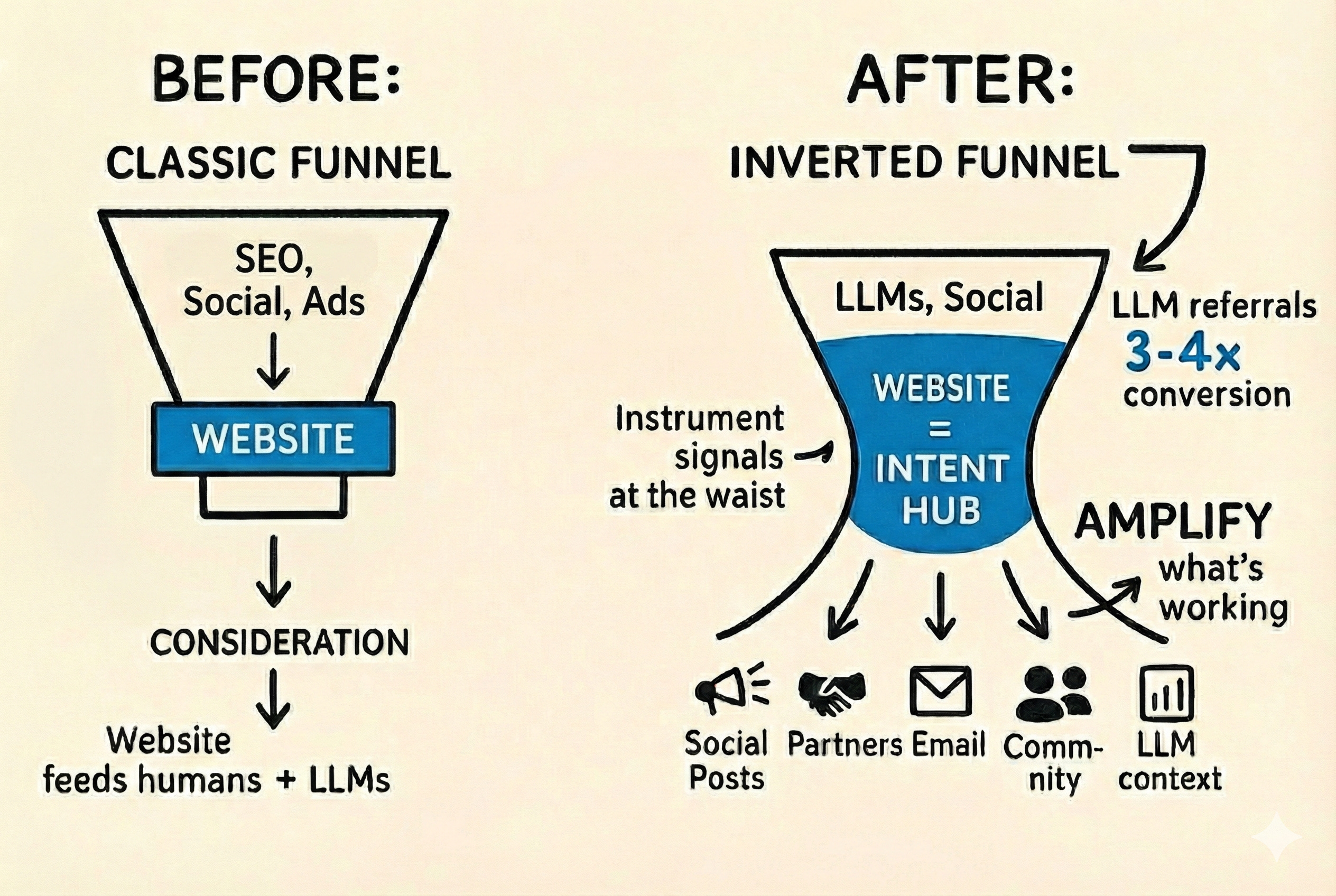
The classic funnel drove traffic down. The inverted funnel captures intent at the center and amplifies it outward.
The Funnel Flipped
For two decades, we ran the same play. Drive traffic to the top of a wide funnel with SEO, social, paid ads and then nurture visitors down through consideration to conversion. The website was the starting point.
That era is over.
Today, buyers do their research before they ever touch your site. They ask ChatGPT. They read a thread on LinkedIn. They hear about you in a Slack community or a podcast. By the time they land on your website, they’re not browsing; they’re deciding.
This is the inverted funnel. Your website used to be the wide mouth at the top. Now it’s the narrow point where intent concentrates. The visitors who make it there carry real signal which is why LLM referral traffic converts 3-4x higher than traditional organic search.
Read that again: the traffic that AI sends you closes better than the traffic Google used to send you.
Your site didn’t lose its purpose. The purpose upgraded from awareness to conversion.
The “Waist” Is Where the Magic Happens
The inverted funnel has a waist - the narrowest point where human visitors arrive with intent. This is where you need to instrument everything.
Most marketing stacks are still optimized for the old funnel. They measure page views, sessions, and bounce rates - vanity metrics from the traffic era. In the inverted funnel, what matters is:
Who showed up (not how many)
Where they came from (LLM referral? Branded search? A partner’s link?)
What they did (pricing page? Security docs? Integration pages?)
How many people from the same account are visiting (one stakeholder or three?)
These are first-party signals that only you have. No competitor can buy them from a third-party vendor. No intent data provider can replicate them. They’re yours.
The Bottom Half: Amplification
Below the waist, it opens back up: wider than the old funnel ever was. This is the amplification zone.
You take the signals from that narrow intent point and fan them out to every channel that touches your buyer: social posts, partner co-marketing, email sequences, community engagement, even the context you feed back to LLMs through your content strategy.
Think of it as a feedback loop. A prospect visits your site from a ChatGPT referral. You capture the signal. You see they’re researching a specific use case. Now you amplify: your team shares relevant content on LinkedIn, your partner mentions you in a webinar, your SDR sends a personalized note that references the exact problem the prospect was researching.
The amplification loop works because it’s informed by real intent, not guesses. And many of the channels you’re amplifying into - social, community, partner content - are the same places LLMs pull from when forming their recommendations. So the loop compounds.
What This Means for Your Team
If you’re a Growth Marketer reading this, here’s the practical upshot:
Stop mourning traffic declines. The volume game is over. A smaller number of high-intent visitors who actually convert is worth more than a firehose of tire-kickers who bounce.
Instrument the waist. If you can’t tell me who visited your site today, where they came from, and what content they engaged with at the account and person level you’re flying blind in the most important part of the funnel.
Invest in the amplification layer. Most marketing teams are still organized around the top of the old funnel. The inverted funnel demands a different muscle: taking bottom-funnel signal and distributing it across channels. This is where in-person events, community, and partnerships become critical; but they need to be fed by signal, not run on vibes.
Reclaim your content strategy for LLMs. Your website now feeds two audiences: humans and AI. The content you publish shapes how LLMs talk about you, which shapes the referral traffic you receive, which shapes the intent you capture. It’s a flywheel, and it starts with content you control on your own domain.
Websites Aren’t Obsolete. They’re the Tip of the Spear.
The question isn’t whether you need a website. The question is whether you’ve upgraded your website’s job to match how buyers actually behave now.
In the old world, your site was a lobby - welcoming, broad, trying to appeal to everyone. In the new world, it’s a signal station - capturing concentrated intent from the few visitors who matter most, then broadcasting what you learn to the channels where your next buyers are forming their opinions.
The funnel flipped. Your website got promoted. The only question is whether your GTM stack noticed.
This is what we think about every day at Syft Data — helping GTM teams capture and act on the first-party signals that matter most. If you’re rethinking how your website fits into your go-to-market, I’d love to hear what you’re seeing. Reply to this email or find me on LinkedIn.